About Bo Peng
I am a Ph.D. student in Computer Science at Shanghai Jiao Tong University (SJTU), advised by Prof. Yu Qiao and working with Dr. Chaochao Lu. I am a member of the Wu Wenjun AI Honors PhD Program and expect to graduate in 2028. I received my bachelor's degree from SJTU's Artificial Intelligence Pilot Program in 2023. My research mainly focuses on Large Language Models, AI Agents and Causality.
I am currently a research intern at Shanghai AI Laboratory (Nov 2022–present).
News
- 2026.08 CauSight is accepted to EMNLP 2026, and CauAudit to Findings of EMNLP 2026!
- 2026.06 CauTion, our framework for deciding when to trust LLMs in ensemble causal discovery, is available as a preprint.
- 2026.05 CauScale is accepted to ICML 2026!
- 2026.04 Our benchmark for multi-day coworker agents, ClawMark, is available as a preprint.
- 2026.01 CauScientist, our framework combining LLMs with statistical verification for causal discovery, is available as a preprint.
Publications
My research has led me to explore three important areas of AI: LLMs and agents, video generation, and causality. Each addresses a different aspect of building AI systems that are useful in the real world.
LLM & Agent
LLMs are increasingly used as agents that collaborate with people, use tools, and carry out tasks over time. My work examines how to evaluate these capabilities in realistic settings, understand whether models truly use visual tools, and adapt dialogue to users' implicit needs.
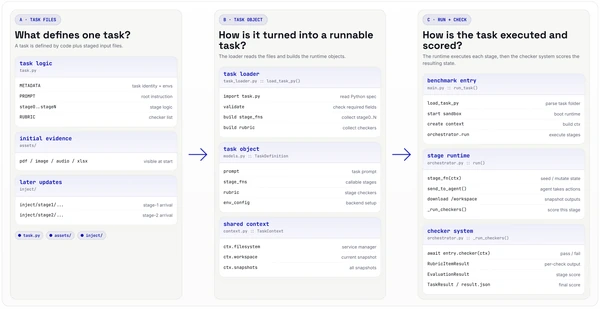
ClawMark: A Living-World Benchmark for Multi-Turn, Multi-Day, Multimodal Coworker Agents
arXiv preprint 2026
A benchmark of 100 coworker tasks across 13 professional scenarios, with evolving service state, raw multimodal evidence, and 1,537 deterministic checks.
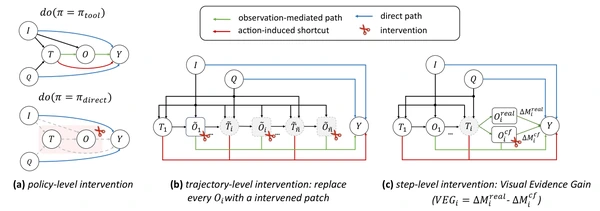
The Illusion of Visual Tool-Use: A Causal Audit of Thinking with Images
EMNLP · Findings 2026
A causal audit of whether visual tool outputs influence model decisions, with interventions at the policy, trajectory, and individual-step levels.
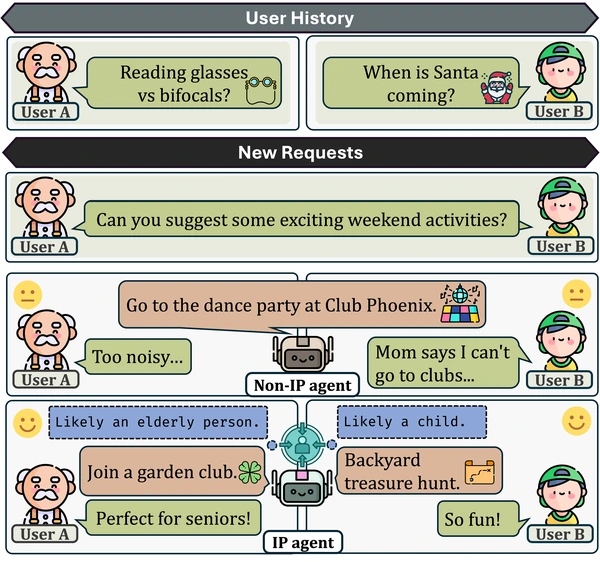
IP-Dialog: Evaluating Implicit Personalization in Dialogue Systems with Synthetic Data
EMNLP · Findings 2025
A synthetic-data benchmark and training pipeline for inferring implicit user attributes from dialogue, covering 10 tasks and 12 attribute types.
Video Generation
Video generation can support filmmaking, animation, and education by making visual storytelling and content creation more accessible. My work explores controllable video generation, using pretrained image models to follow motion conditions while maintaining temporal consistency without additional training.
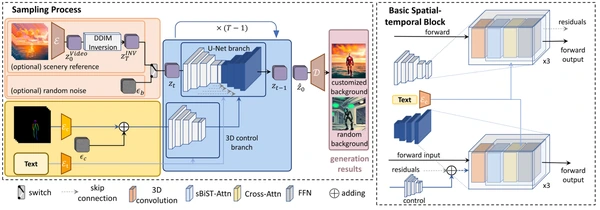
ConditionVideo: Training-Free Condition-Guided Video Generation
AAAI 2024
Training-free video generation using pretrained image diffusion models, with condition-guided motion and improved temporal coherence.
Causality
Causal reasoning helps us move beyond correlations to understand why things happen and what might change when we intervene. It is essential for scientific discovery and informed decision-making. My work spans causal evaluation of language and vision-language models, visual and scalable causal discovery, and combining LLM knowledge with statistical evidence.
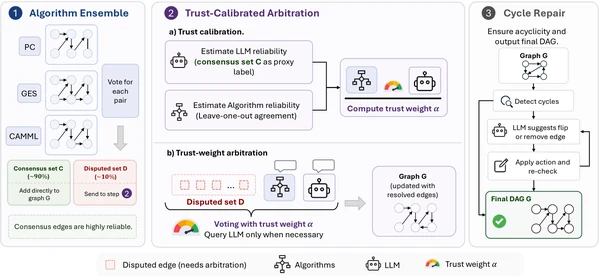
CauTion: Knowing When to Trust LLMs for Ensemble Causal Discovery
arXiv preprint 2026
Combines statistical algorithm consensus with reliability-calibrated LLM arbitration to resolve disputed causal relations, followed by cycle repair.
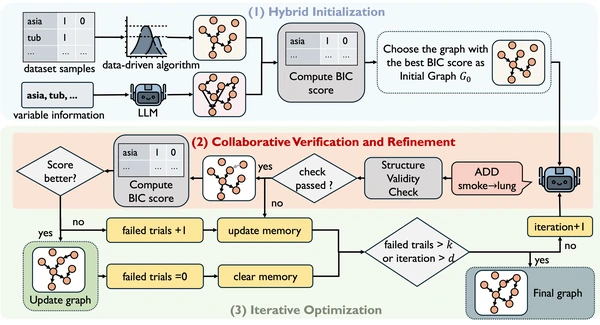
CauScientist: Teaching LLMs to Respect Data for Causal Discovery
arXiv preprint 2026
Combines LLM-proposed causal hypotheses with statistical verification and error memory to guide causal structure search.
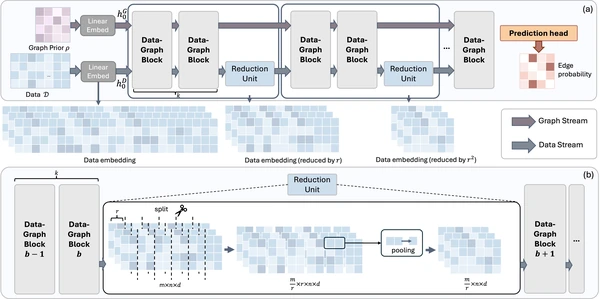
CauScale: Neural Causal Discovery at Scale
ICML 2026
An efficient neural architecture for causal discovery, scaling inference to graphs with up to 1,000 nodes through a two-stream design and shared attention.
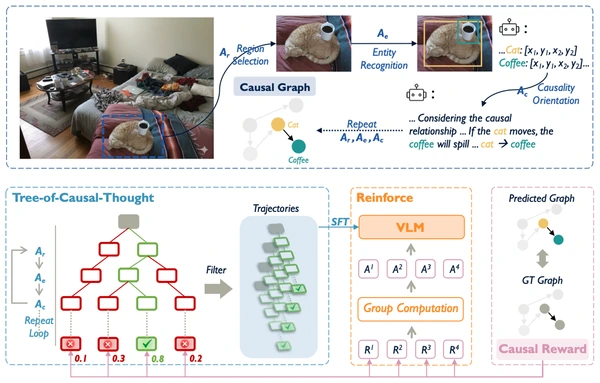
CauSight: Learning to Supersense for Visual Causal Discovery
EMNLP 2026
Visual causal discovery from images through VCG-32K, synthesized reasoning trajectories, and reinforcement learning with causal rewards.
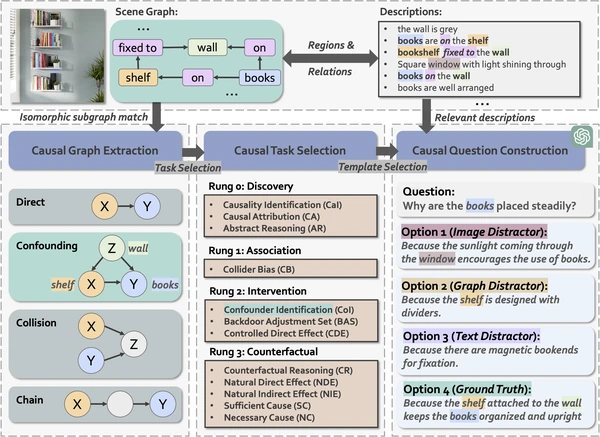
CELLO: Causal Evaluation of Large Vision-Language Models
EMNLP 2024
Evaluates visual causal reasoning through 14,094 questions spanning discovery, association, intervention, and counterfactual reasoning.
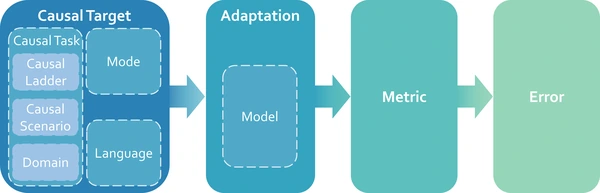
Causal Evaluation of Language Models
Shanghai AI Lab Technical Report 2024
A comprehensive analysis of the causal reasoning capabilities of language models, using a dataset of 126,334 samples.
Open-Source Tools
- Paper-Researcher [GitHub]
A Python MCP toolkit for literature retrieval and citation-network exploration using Semantic Scholar, with bounded traversal, resumable checkpoints, and traceable discovery.
Education
- 2023 – 2028 (expected), Ph.D. in Computer Science, Shanghai Jiao Tong University.
Advisor: Prof. Yu Qiao. Wu Wenjun AI Honors PhD Program. - 2019 – 2023, Bachelor's degree, Shanghai Jiao Tong University.
Artificial Intelligence Pilot Program. GPA: 3.83 / 4.3.
Internships
- Nov 2022 – Present, Research Intern, Shanghai Artificial Intelligence Laboratory.